

Beginner Graphic Designer: How to Land Your First Paid Job Before the Course Ends, Build a Portfolio Fast and Win Clients Without Experience
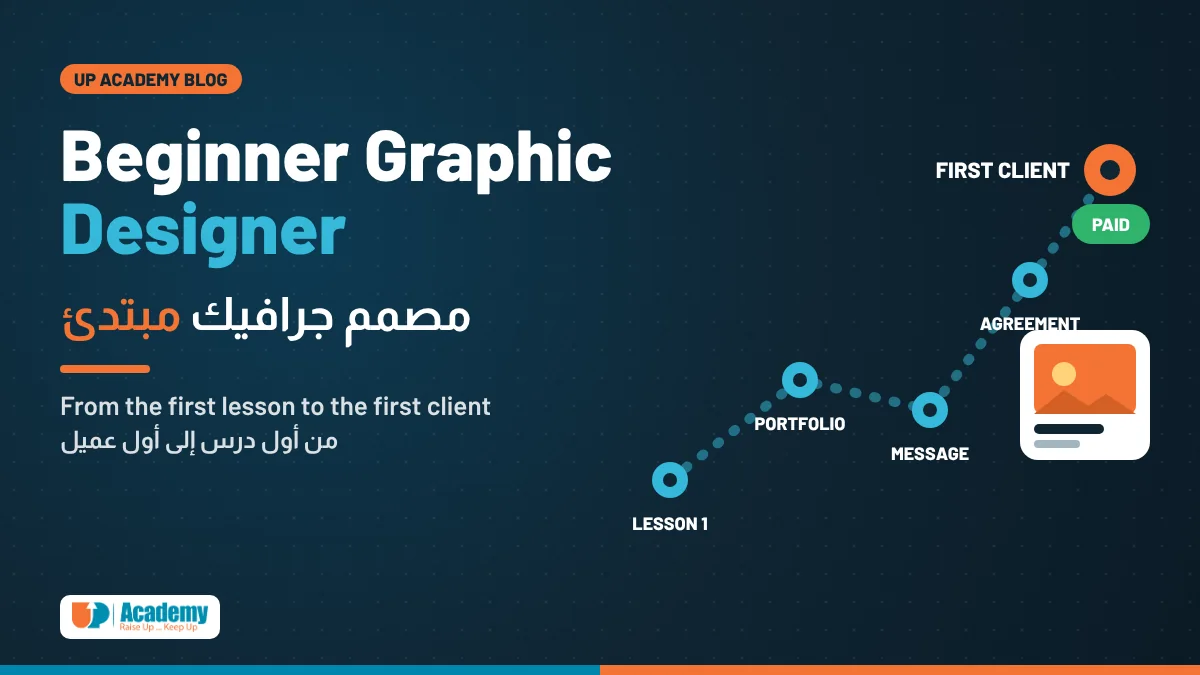
Beginner Graphic Designer: Your First Paid Job Can Start Before the Course Ends
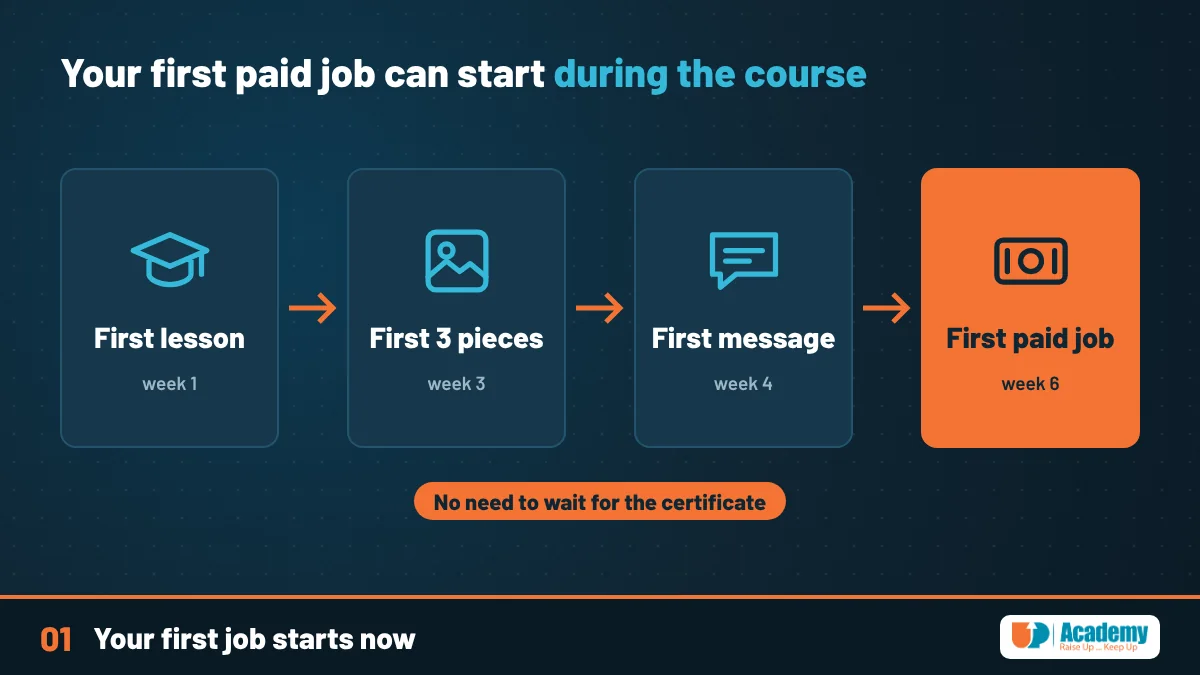
Almost every beginner graphic designer asks the same question in the first weeks: “Who will hire me when I have no experience?” The fear is understandable. You see designers online with years of work and thousands of followers, and you are still learning where the Pen tool is. But the honest answer is that your first paid job does not need years. It needs proof that you can do one specific thing well, and a client who trusts you enough to try.
Experience is only one way to create that trust. Clients also trust what they can see (a few strong samples), what they understand (a clear way of working), and who stands behind you (an academy, an instructor, a review before delivery). A student who has all three can win a small first job in the middle of a course, and many do. The first job is usually small: four social media posts, ten product photos, a menu. That is exactly why it is reachable.
In this guide we put together what we tell our students in the graphic design courses at UP Academy, from the first lesson to the first client. It is the same road we cover with students in the weekly live sessions, and it works whether you study the full Master Graphic Design Diploma or a single course.
Key takeaways
- Clients do not buy years of experience, they buy confidence in the result. Proof of work, a clear process and someone to back you up can replace a long CV.
- Start marketing yourself in week one, not after the certificate. Say what you design, for whom, and show it, even if it is three pieces.
- Every assignment is a portfolio piece when you apply it to one field or one demo brand and present it as a short case study.
- Take jobs that match what you have already learned, and ask your instructor before you say yes to anything bigger, technical or printed.
- Below you will find where first clients come from, a first message, brief questions, a table of jobs to accept or decline, pricing, delivery, mistakes, a checklist and six FAQs.
In this article
- Beginner Graphic Designer: Your First Paid Job Can Start Before the Course Ends
- What “No Experience” Really Means to a Client
- Market Yourself as a Graphic Designer From Week One
- Choose One Starter Service That Matches What You Have Learned
- Build Your Graphic Design Portfolio During the Course, Not After It
- No Clients Yet? Use Practice Briefs and Concept Projects Honestly
- Present Each Piece as a Short Case Study: Behance, Instagram and a PDF
- Where a Beginner Graphic Designer Finds the First Client
- Your First Message to a Business: Short, Specific, Helpful
- How to Convince a Client Without Experience: Five Things to Say and Show
- The Design Brief: Questions to Ask Before You Open Photoshop
- Which Jobs to Accept and Which to Decline as a Beginner
- Got a Job Offer? How to Lean on Your Instructor the Right Way
- Pricing Your First Design Job Without Underselling Yourself
- A Simple Written Agreement and a Deposit Protect Both Sides
- Delivering Design Files Like a Professional
- Handling Feedback and Revisions Without Losing Confidence
- After the First Job: Testimonials, Case Studies and Referrals
- Confidence for a Beginner Designer: Impostor Feelings and Speed Through Repetition
- Common Mistakes That Cost a Beginner Graphic Designer the First Clients
- Beginner Graphic Designer Checklist: From the First Lesson to the First Client
- Beginner Graphic Designer: Frequently Asked Questions
What “No Experience” Really Means to a Client
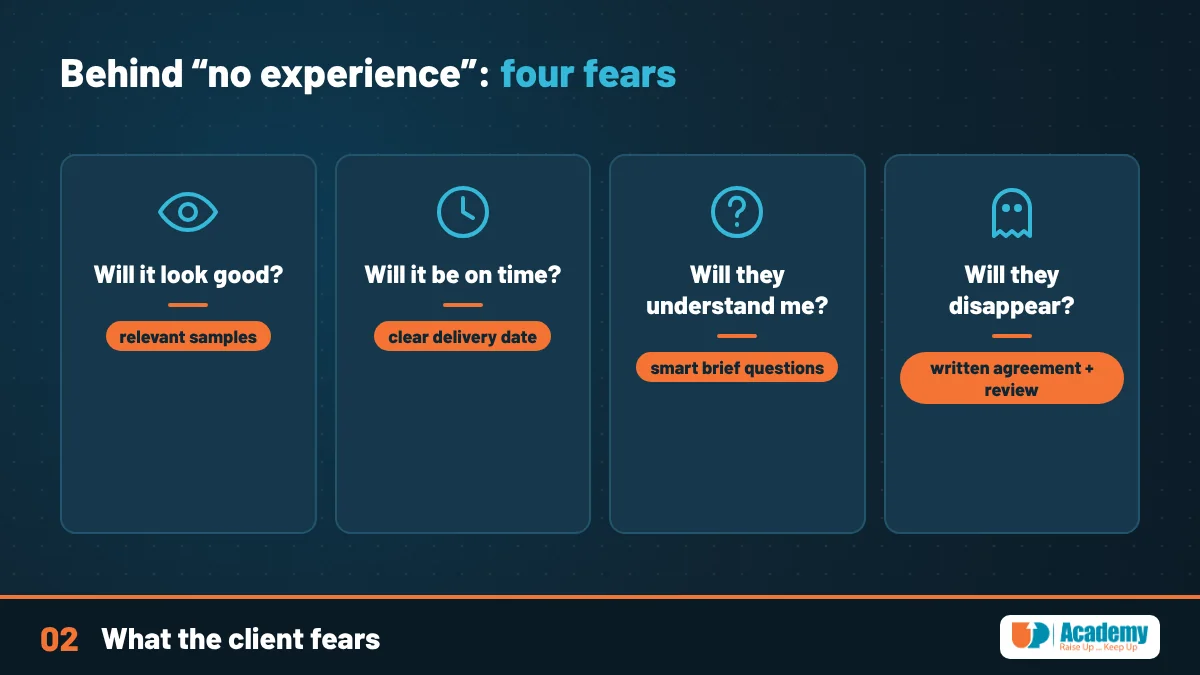
When a client hesitates because you are new, they are not judging your talent. They are managing risk. Behind “do you have experience?” there are four quiet questions: Will the result look good? Will it arrive on time? Will this person understand what I want? Will they disappear in the middle? Experience answers all four at once, which is why clients ask for it. But each question can also be answered separately.
Quality is answered by samples that look like the job, not by many random samples. Time is answered by a clear delivery date and small updates. Understanding is answered by the questions you ask before you design. Reliability is answered by a written agreement, a professional tone and, for a student, by saying honestly that your work is reviewed by an instructor. You are not hiding the gap, you are filling it with proof.
Keep this list in mind for every step that follows. The portfolio answers the first fear, the brief answers the third, the agreement answers the second and fourth. When a client still says no, it is usually because one of these four was left open, not because you are a beginner.
Market Yourself as a Graphic Designer From Week One
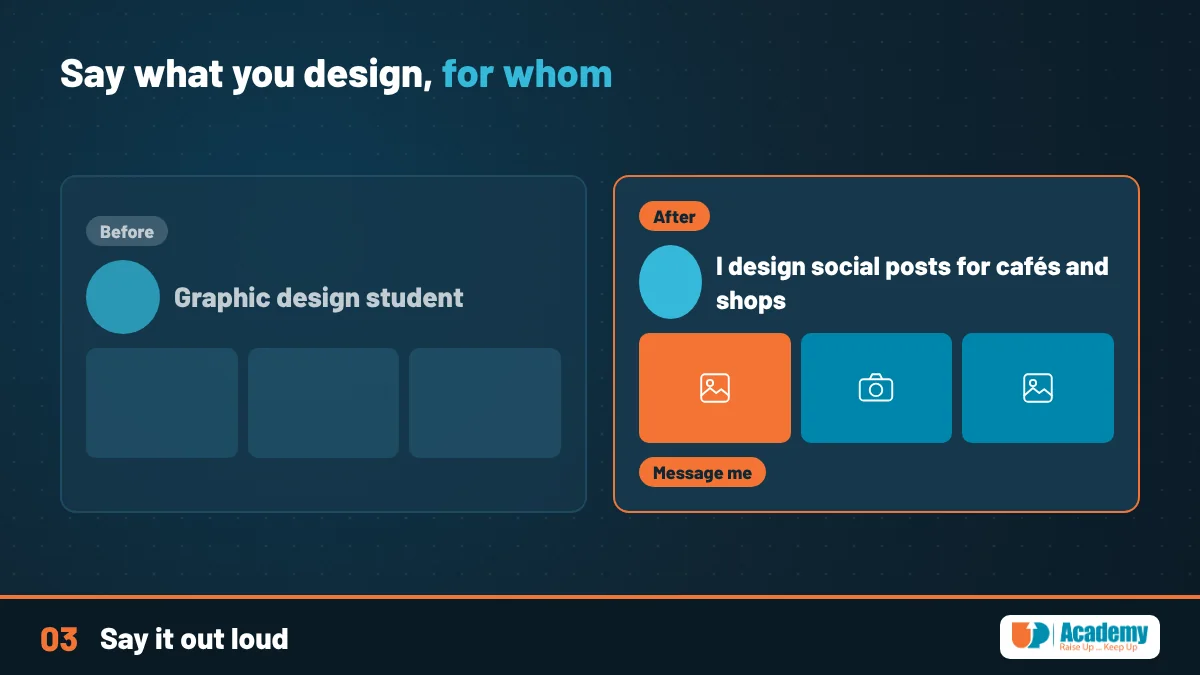
Most students wait until they “feel ready” before telling anyone they design. That day rarely comes on its own. Start in the first week with one sentence that is true today: “I design social media posts for small cafés and shops” is true after your first Canva or Photoshop lessons. “Graphic design student” describes your situation; “designer for a specific field” describes a service, and a service is what people hire.
Put that sentence everywhere people already know you: your Instagram and Facebook bio, your WhatsApp status, LinkedIn if you use it. Then post what you make, every week, even small exercises. Each post is a reminder to your circle that you now do this. People rarely hire the best designer they have never heard of; they hire the designer they remember when they need a post or a menu.
Share the process, not only the final image: a before and after, a short screen recording, “today I learned how to cut out a product cleanly”. This is honest, because you are learning, and it builds trust, because people see you improving. Marketing yourself is not bragging; it is simply making your work visible. If you want the bigger picture of why visibility matters, our article on the history of marketing shows how every era rewarded the sellers who were seen.
Choose One Starter Service That Matches What You Have Learned
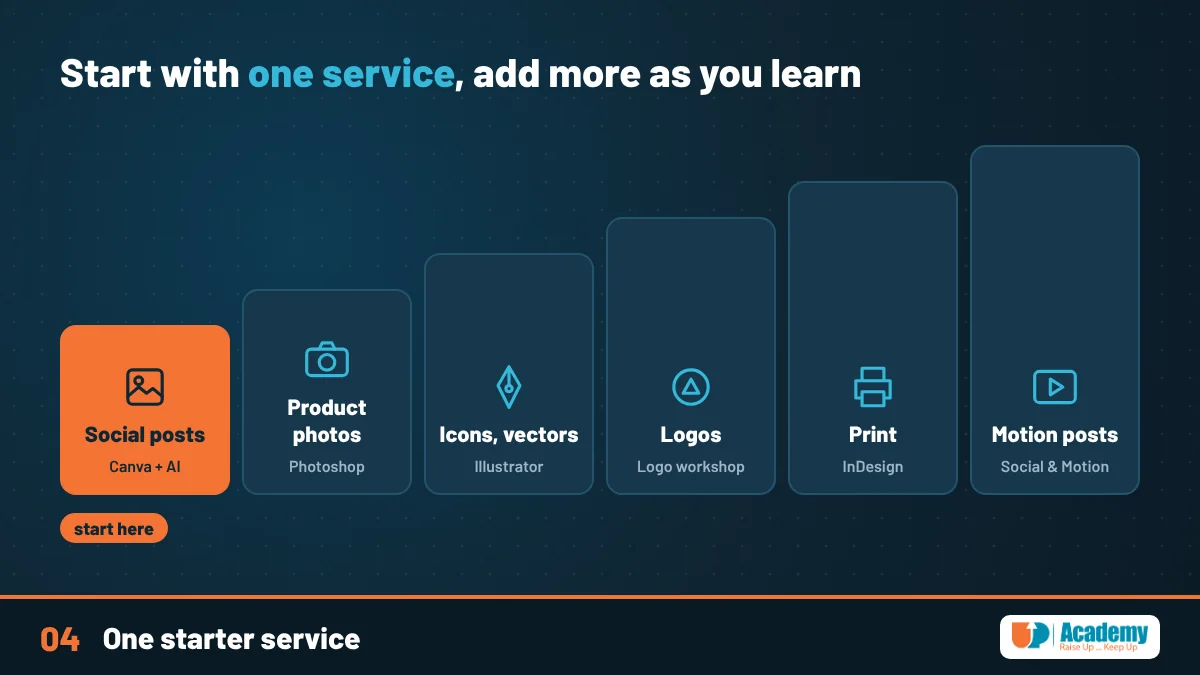
A beginner who offers “all kinds of design” sounds unsure. A beginner who offers one clear service sounds like a specialist, even with little experience. Pick the service that matches the stage you have reached in your course, not the stage you hope to reach. Your offer will grow naturally as you learn more.
In our diploma the order is deliberate. After Design Foundations and Canva + AI, you can already offer clean social media posts and stories. After Photoshop + Camera Raw, you add product photo retouching, background removal and ad composites. Illustrator opens icons, vector illustrations and simple print pieces. Logos and identities come later, in the Logo & Brand Identity Workshop, because a logo is a bigger responsibility than a post.
A good starter service has three qualities: it is small (a few hours, not weeks), it is repeatable (a café needs new posts every week), and it is easy to judge (the client can see at once whether it works). Social media posts and product photos fit all three, which is why most of our students get their first paid job there.
Build Your Graphic Design Portfolio During the Course, Not After It
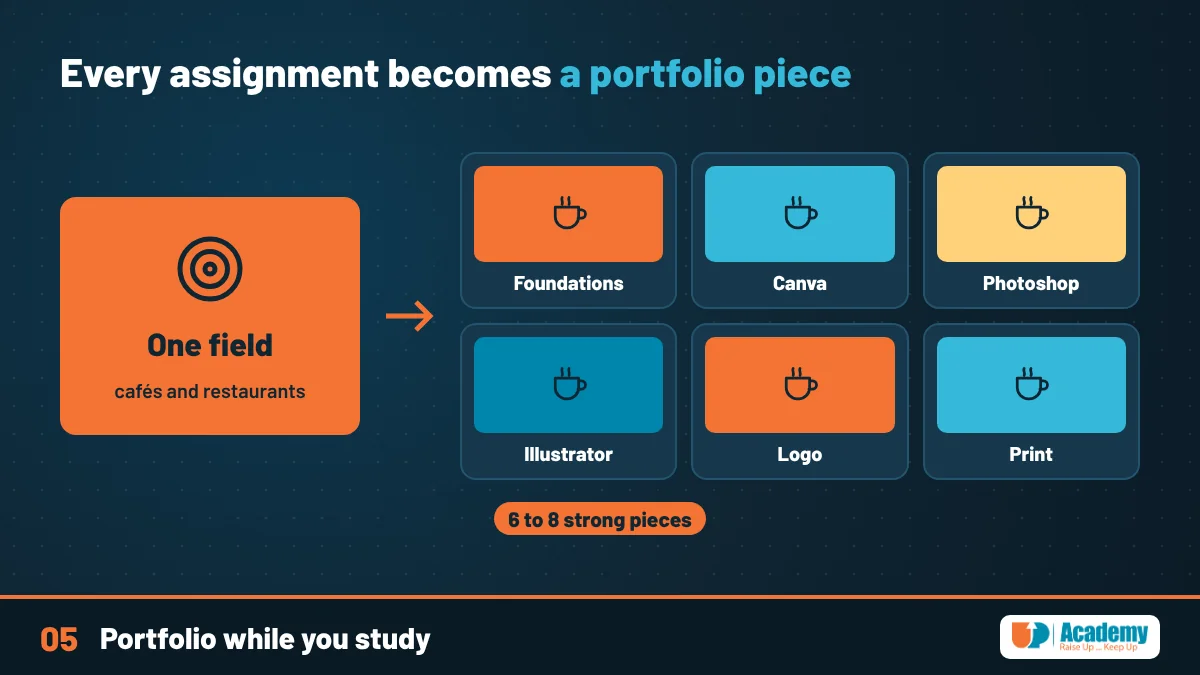
The biggest mistake students make with the portfolio is treating it as a final project. By the time they finish the course, they have dozens of exercises on random subjects and nothing a client would recognise as “my kind of work”. The fix is simple: decide your field early and do every assignment on it. If you want to work with restaurants, every exercise becomes a restaurant post, a menu detail, a food photo.
This is why every module in our diploma starts with a ready Starter Brand Kit: a demo brand with a brief, colours and fonts, so your assignments build one coherent body of work instead of scattered pieces. If you have your own field, use it instead. Either way, after three or four modules you already have a small portfolio that looks like a real service.
Aim for six to eight strong pieces, not thirty average ones. A client looks for one thing: work that resembles their project. Three excellent café posts convince a café owner more than twenty mixed designs. Remove weak pieces without mercy, and replace old work as your level rises. A portfolio is a living document, not an archive.
No Clients Yet? Use Practice Briefs and Concept Projects Honestly
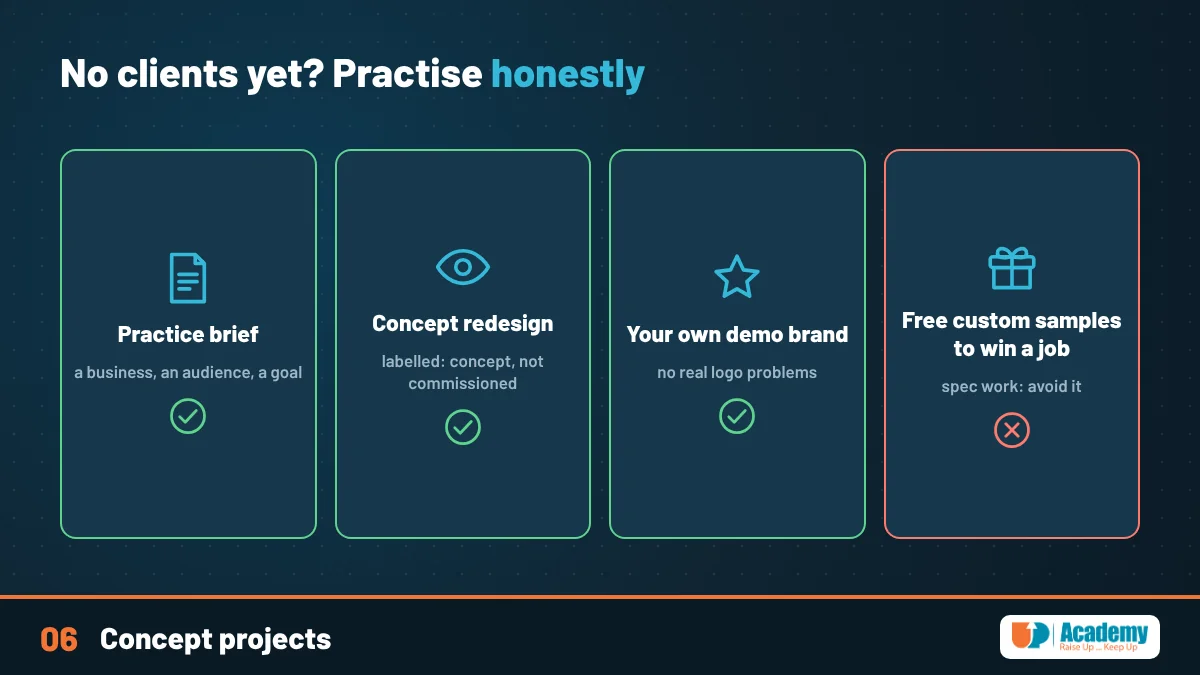
You do not need a paying client to produce client-like work. Practice briefs give you a business, an audience and a goal, so you design for a purpose instead of decoration. Our diploma includes ready briefs for demo brands, and you can write your own: “a new juice bar near a university, target students, needs a launch post and a menu”.
A concept redesign is another strong option: take a real local shop whose posts are weak and design what you would do. Two rules keep this honest. Label it clearly as “concept, not commissioned”, and never present it as client work. Many designers also avoid publishing a real company’s logo in an unofficial redesign; using your own demo brand removes the problem completely.
What you should not do is send free “sample designs” to a client who is choosing between several designers. That is spec work, and it trains clients to expect free work from beginners. A self-made concept that you show to explain your style is fine; a custom design made for free to win the job is not. If someone asks for a free test, offer your relevant samples and a small paid first task instead.
Present Each Piece as a Short Case Study: Behance, Instagram and a PDF
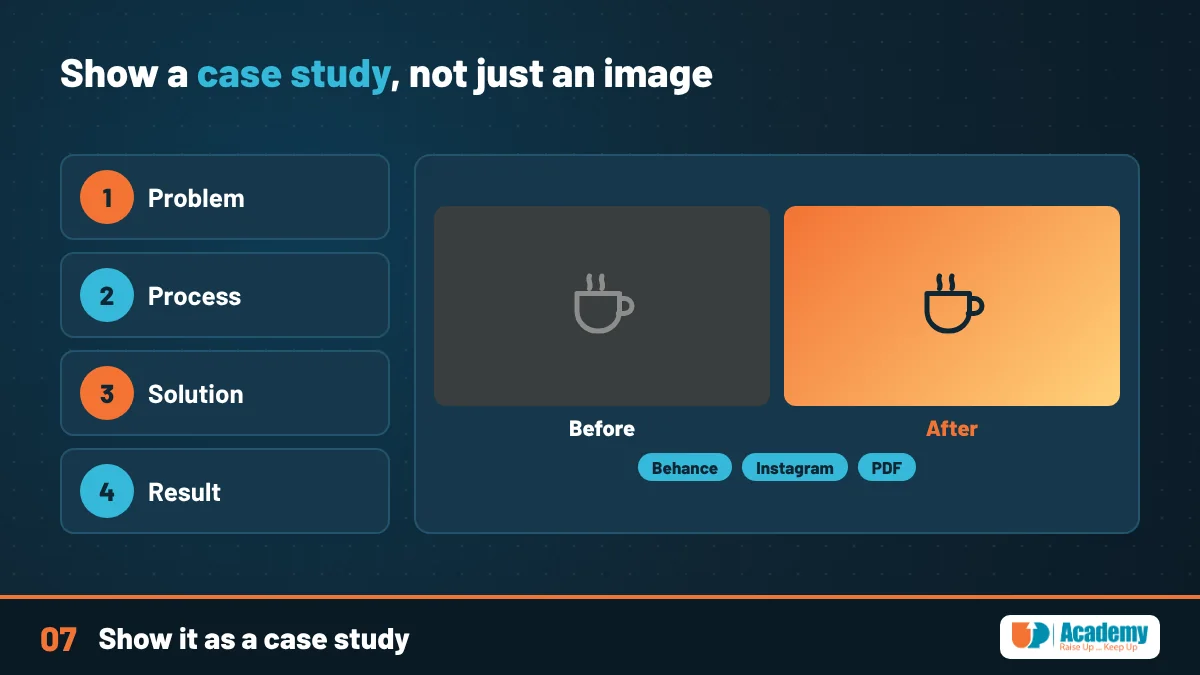
A single final image says “I can make something pretty”. A short case study says “I can solve your problem”, which is what clients pay for. Use four steps for every piece: the problem (what the business needed), the process (sketches, choices, a discarded idea), the solution (the final design) and the result (what changed, or what it is built to achieve).
Before and after is the most convincing format for a beginner. A dull product photo next to your retouched version, an old menu next to your redesign: the client understands your value in one second without reading anything. Two short lines of text under each image are enough.
Publish in three places. Behance is Adobe’s platform for creative portfolios and the link designers send to agencies. Instagram is where local clients actually see your work. And a light PDF portfolio of eight to twelve pages is what you attach to job applications. Building all three step by step is the subject of the Portfolio & Freelance course at the end of the diploma, but you can start the Behance profile today.
Where a Beginner Graphic Designer Finds the First Client
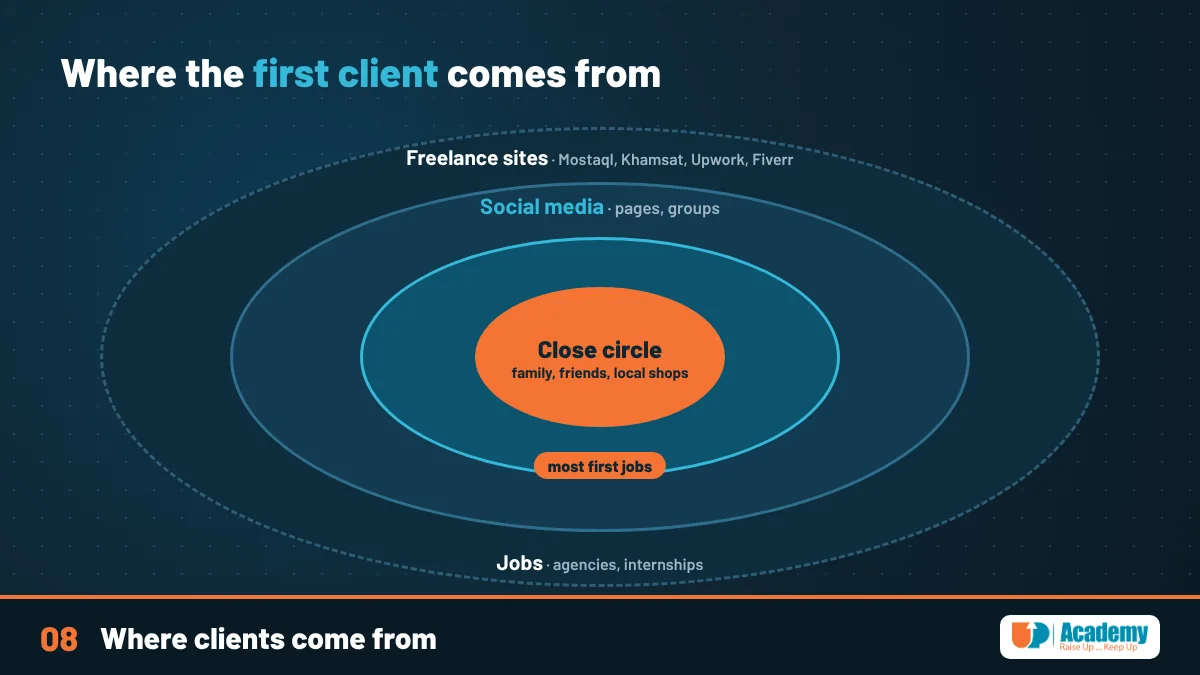
Think of possible clients as circles around you. The closest circle is the most likely to give you the first job: family, friends, neighbours, the café you visit, the shop of a relative, a friend starting a small online business. They already trust you as a person, so the experience gap matters less. Most first jobs come from here, and that is nothing to be shy about.
The second circle is social media: local business pages that post rarely or badly, Facebook groups for small businesses and home projects, and people who see your weekly posts. The third circle is freelance platforms such as Mostaql and Khamsat in the Arab world, and Upwork and Fiverr internationally. They have more competition, so a focused profile and relevant samples matter even more there.
The fourth path is a job or internship in an agency or a company’s marketing team, even part-time. You learn speed, teamwork and deadlines faster than anywhere else. These paths are not exclusive: many designers keep a job and take small freelance projects, then grow into their own studio. Start with the circle where trust already exists.
Your First Message to a Business: Short, Specific, Helpful
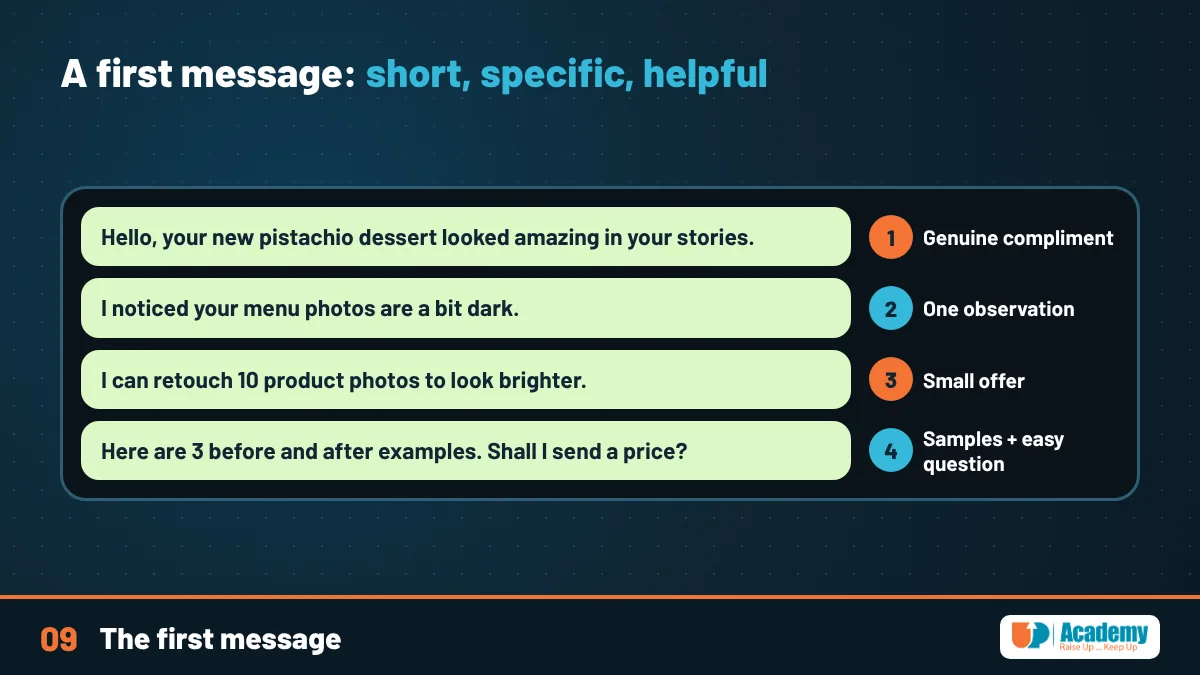
A message that says “Hi, I am a graphic designer, do you need designs?” is easy to ignore. A good first message shows that you looked at their business and have a small, concrete idea. Four parts are enough: something genuine you like about them, one specific observation, a small offer, and a link to two or three relevant samples.
For example: “Hello, I love your new pistachio dessert, it looked amazing in your stories. I noticed your menu photos are a bit dark on Instagram. I am a designer specialised in cafés and I can retouch ten of your product photos so they look brighter and more appetising. Here are three before and after examples. Would you like me to send a price for ten photos?” It is polite, it is specific, and it ends with an easy yes or no.
Do not attack their current design (“your page is ugly”), do not send a long CV, and do not send ten messages a day to the same person. Send a few good messages every week, track who answered, and follow up once, kindly, after a few days. Treat it as practice: each message makes the next one better, and you only need one yes to start.
How to Convince a Client Without Experience: Five Things to Say and Show
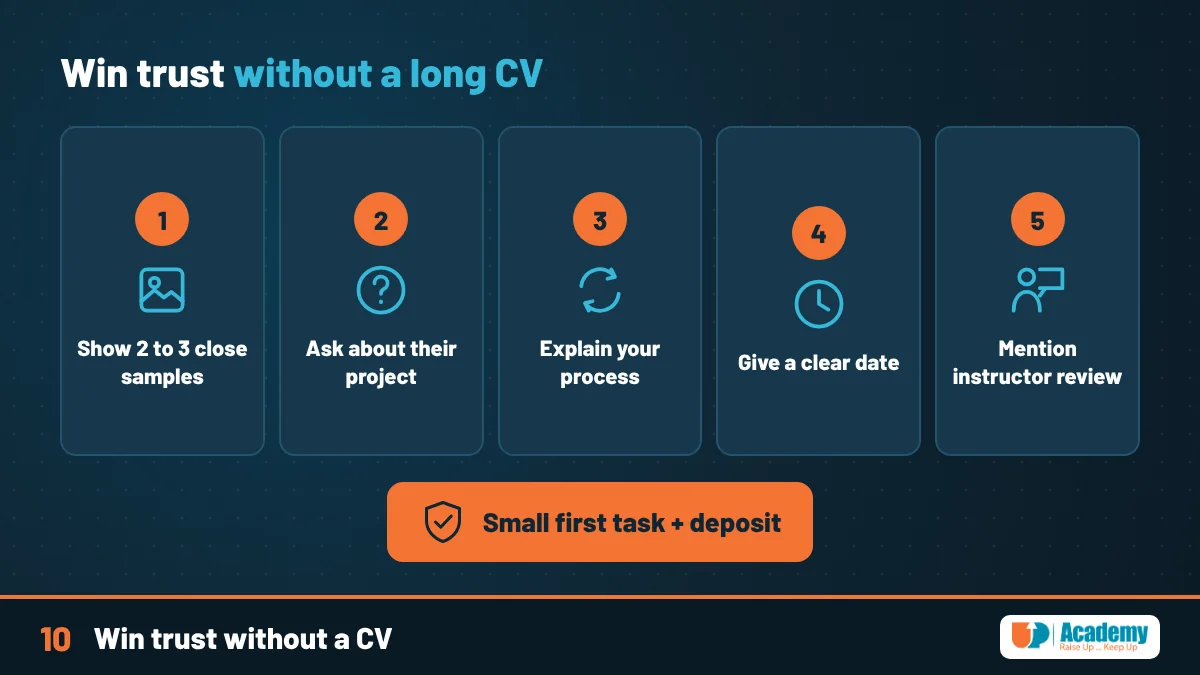
When a client is interested but unsure, do not argue about experience. Change the subject to their project. Ask about their customers, their goal and what they did not like before. A beginner who asks good questions sounds more professional than an experienced designer who only talks about himself. Then show the two or three samples closest to their request, not your whole portfolio.
Next, explain your process in one or two sentences: “I will send you two directions in two days, you choose one, then we have two rounds of revisions and I deliver the final files on Thursday.” A clear process removes the fear of the unknown. Then be honest about your situation as a strength: “I am finishing a graphic design diploma, and my work is reviewed by my instructor before delivery.” Honesty plus a safety net is more convincing than pretending.
Finally, lower the risk for them. Start with a small first task (four posts instead of a monthly package), set a clear deadline, and ask for a deposit so both sides are committed. If they still hesitate, thank them and leave the door open. A polite “no” today often becomes a “yes” in two months, when they see you still posting good work.
The Design Brief: Questions to Ask Before You Open Photoshop
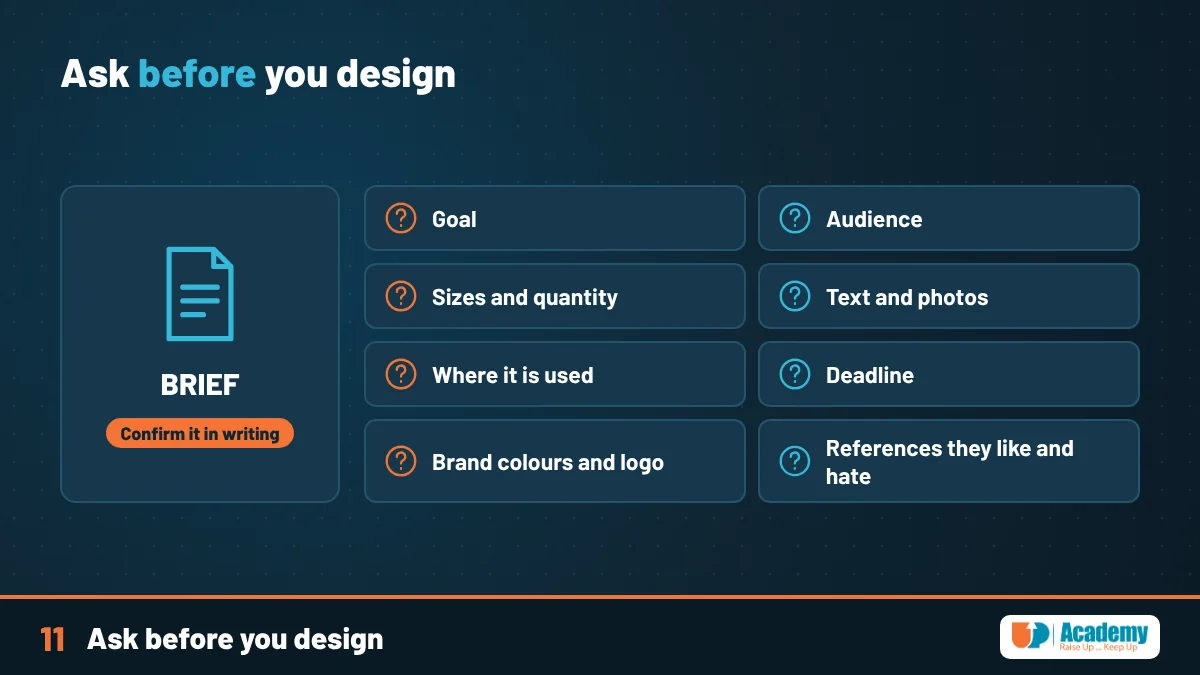
Most problems with first clients start before the design, when the designer did not ask enough. A creative brief is simply the written answer to “what exactly are we making, for whom and why?”. For a small job it can be ten lines in a WhatsApp message. Write it, send it back to the client and ask: “Is this correct?” Their “yes” protects you later.
The essential questions: What is the goal (sell a product, announce an opening, build awareness)? Who is the audience? What are the sizes, formats and quantity? Who provides the text and photos, and in which language? Where will it be used: Instagram, print, a screen in the shop? When is the deadline? Are there brand colours, fonts or a logo file? And which designs do they like or dislike, with examples?
The last question is often the most useful. Asking for two or three references the client likes, and one they hate, saves you hours of guessing. If the client cannot answer most of these questions, that is not a reason to refuse; it is a reason to help them think, which is part of your value. In the Orientation & Brief course you practise reading and writing briefs from the very first module.
Which Jobs to Accept and Which to Decline as a Beginner
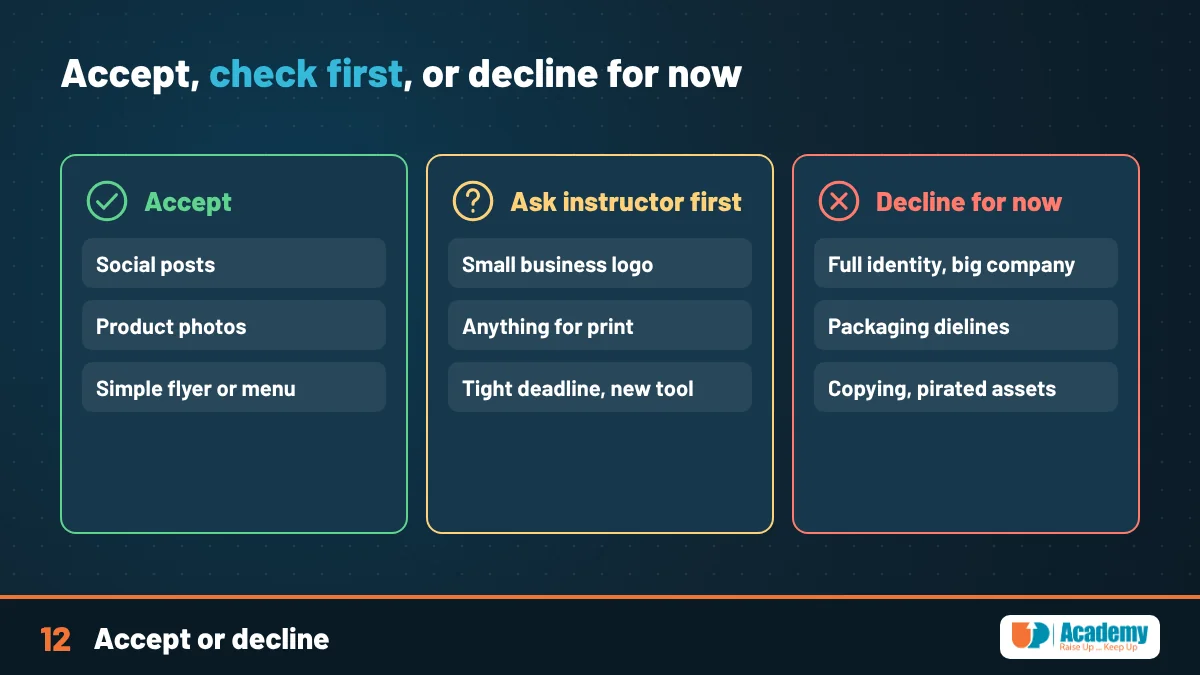
Saying yes to everything is the fastest way to lose your first clients. Accept jobs that match skills you have already practised, have a clear scope and a reasonable deadline: social media posts, product photo editing, a simple flyer or a menu for a small shop. These let you deliver well, and delivering well is what brings the second job.
Some jobs are a “yes, but check first”: a logo for a small local business, anything going to print, a job with a tight deadline or a new tool. You may be able to do them, but they hide technical traps such as print sizes, bleed and CMYK colour, file formats or trademark-like similarities. Before you agree, send the brief to your instructor and ask: can I do this at my level, and what should I watch out for?
And some jobs you should decline or postpone for now: a full brand identity for a large company, packaging with technical dielines, video or motion if you have not studied it, websites and apps if UI design is not your field (that is a separate specialty in our UI/UX Design with Figma course), copying another brand’s logo, or using pirated fonts and images. Declining politely, or suggesting a smaller first step, builds more trust than accepting and failing. The table below sums it up.
| Job type | As a beginner | Course that prepares you | Before you say yes |
|---|---|---|---|
| Social media posts and stories | Accept early | Canva + AI, Photoshop | Sizes, quantity, who writes the text |
| Product photo editing | Accept | Photoshop + Camera Raw | Get the original high-resolution photos |
| Icons and simple illustrations | Accept with practice | Adobe Illustrator | Style references and final formats |
| Flyer, menu, business card | Check with instructor | InDesign & Print Workshops | Printer size, bleed, CMYK, a test print |
| Logo for a small local business | Check with instructor | Logo & Brand Identity Workshop | Research, similarity check, usage files |
| Motion posts and reels | After studying motion | Social Media & Motion | Length, format, music licence |
| Full identity for a large company | Postpone or partner | After the full diploma and real projects | Refer it or join a senior designer |
| Website or app interface | Separate specialty | UI/UX Design with Figma | Do not mix it with graphic jobs |
Got a Job Offer? How to Lean on Your Instructor the Right Way
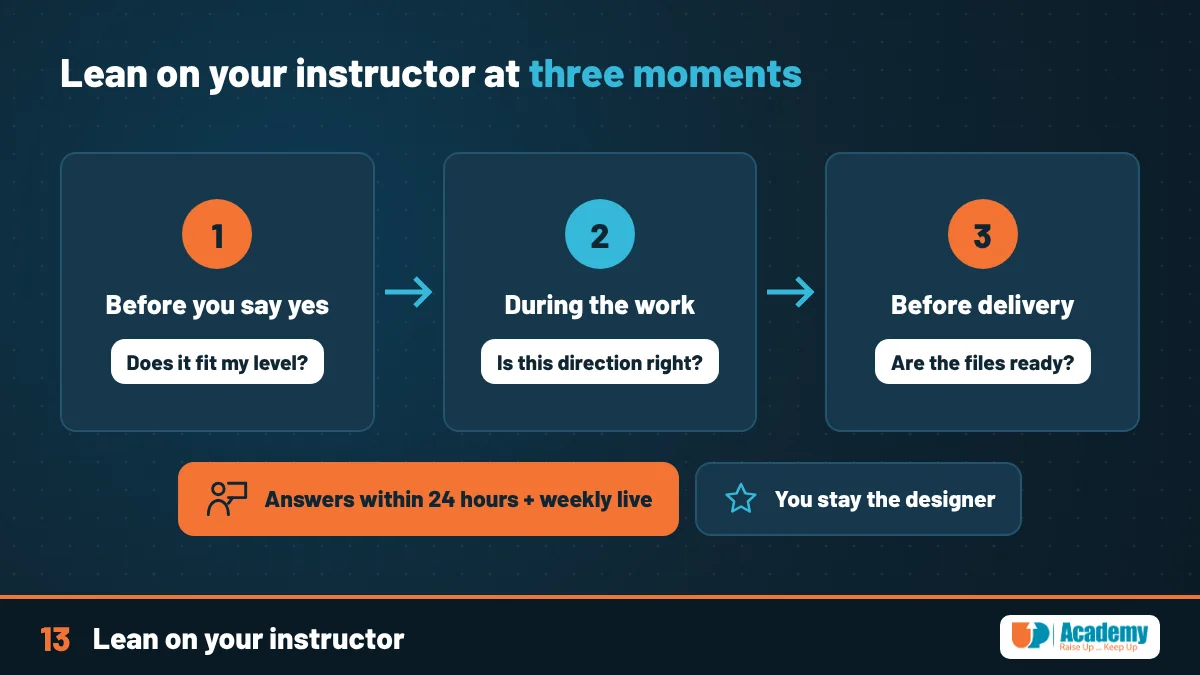
One of the biggest advantages of learning with a real instructor is that you do not face your first client alone. Use that advantage at three moments. Before you say yes, send the brief and ask whether the job fits your level and what to watch out for. During the work, share your first direction for a quick opinion. Before delivery, ask for a final check of the files, especially anything for print.
Make it easy for your instructor to help. Send the brief in a few lines, the client’s references, your draft as an image, and one clear question: “Is the hierarchy right?”, “Is this file ready for the printer?”, “What price range is reasonable?” A focused question gets a useful answer; “what do you think?” gets a general one. Remember that you stay the designer: the instructor guides and reviews, you make the decisions and do the work.
At UP Academy you can ask from inside any lesson through the Notes & Questions panel, and the team answers within 24 hours. Students of the Photoshop course also join a weekly live session every Saturday at 6 PM Cairo time, where we review real student work and break down designs they found online. Bring your client job there: it is the best possible exercise for everyone in the session.
Pricing Your First Design Job Without Underselling Yourself
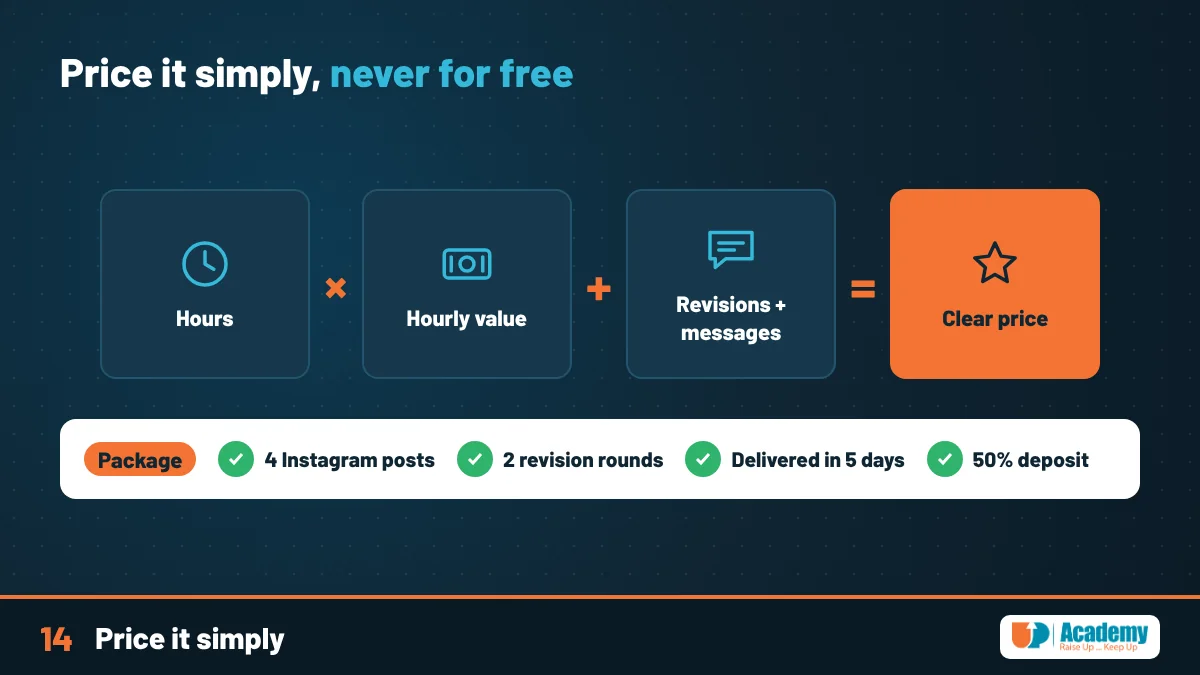
Beginners usually make one of two pricing mistakes: they work for free “for the experience”, or they copy the price of a senior designer and hear nothing back. A simple method protects you from both. Estimate the hours honestly, including revisions, messages and file preparation, multiply them by a modest hourly value, and round to a clear number. A beginner is slower, so it is fair to charge a lower hourly value, not to work unpaid hours.
Then present the price as a package, not as “how much is a design?”. “Four Instagram posts with two rounds of revisions, delivered in five days, for X” is easy to understand and easy to accept. Packages also make your second sale easier: the same client can order the next four posts without a new negotiation.
Look at what similar services cost in your market before you set numbers, for example on local freelance platforms, and ask your instructor if you are unsure. An introductory price for the first client is fine if you say it is introductory and say when it ends. What is not fine is a price so low that you rush the work or resent the client. Pricing by market, Egypt versus the Gulf and international clients, is covered in detail in the Portfolio & Freelance course.
A Simple Written Agreement and a Deposit Protect Both Sides
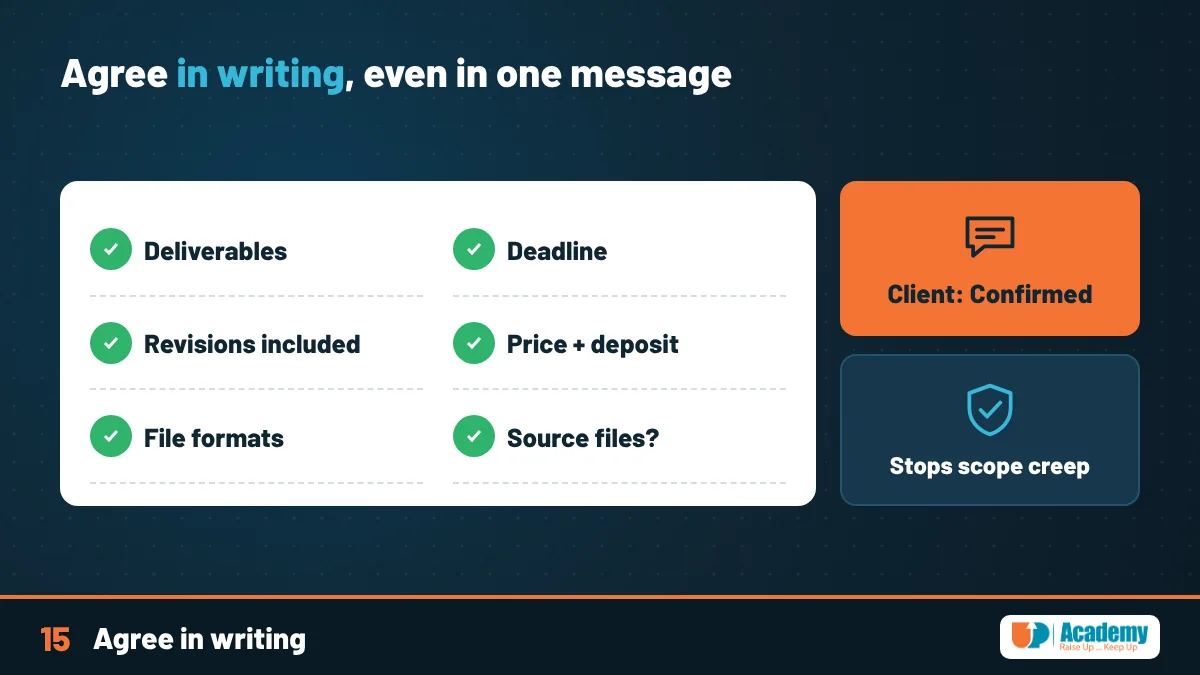
A small job does not need a legal contract, but it does need a written agreement. One message that the client confirms is enough: what you will deliver, by when, how many revision rounds are included, the price, the deposit, the file formats, and whether the source files are included. Writing it down is not a sign of distrust; it is a sign of professionalism, and serious clients respect it.
Ask for a deposit before you start, commonly half of the price, and the rest before you send the final high-resolution files. The deposit protects you from clients who disappear, and it protects the client too, because it shows you are committed. Clients who refuse any deposit on a small job are often the ones who later refuse to pay.
The revisions line matters most. Without it, a small job can turn into endless changes, a problem known as scope creep. “Two rounds of revisions are included; extra rounds or new requests are priced separately” is a calm sentence that saves friendships. Contracts, deposits, revisions and scope creep each have a short lesson in the Portfolio & Freelance course.
Delivering Design Files Like a Professional
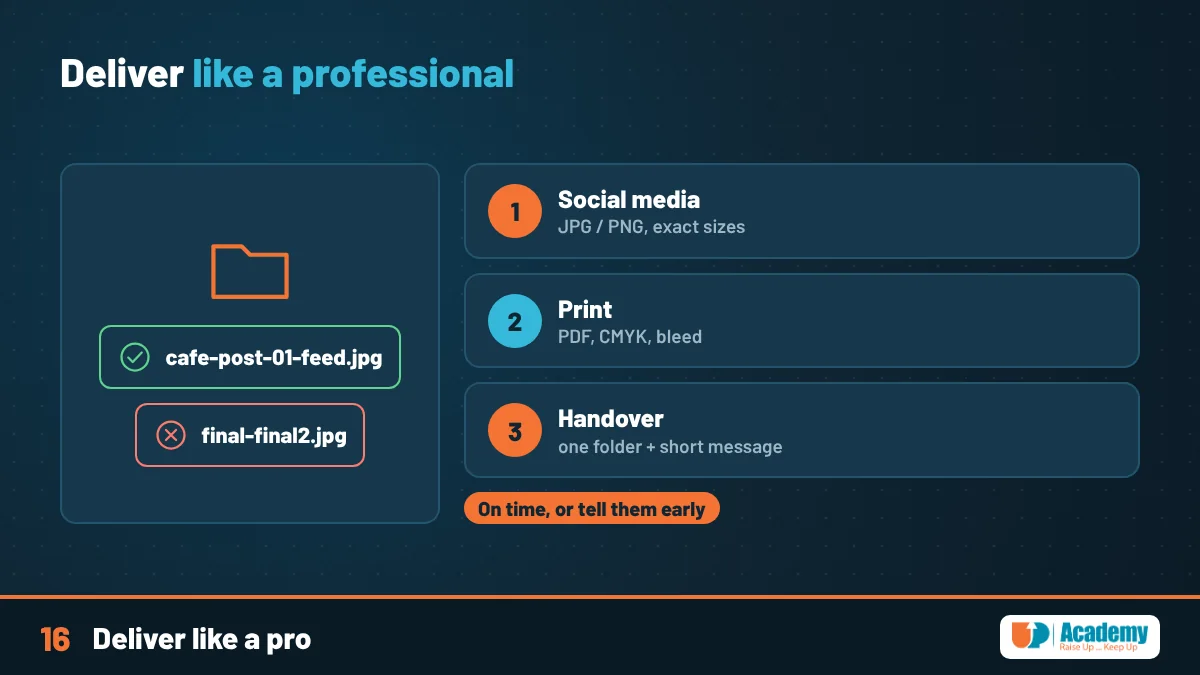
The delivery is the last thing the client experiences, so it shapes how they remember the whole job. Deliver on time or early, and if anything delays you, tell the client before the deadline, not after. A short update in the middle (“the first two posts are ready, sending the rest tomorrow”) makes even a beginner look organised.
Prepare the files properly. Name them clearly (cafe-post-01-feed.jpg rather than final-final2.jpg). Export social media designs at the right sizes in JPG or PNG. For print, export a PDF in CMYK with the bleed and margins the printer asked for, and if possible send a test to the printer before the full run. Put everything in one organised folder or a cloud link.
Finish with a short handover message: what is in the folder, which file is for what, and a thank you. If source files are part of the agreement, include them; if not, keep them safe in case the client needs a change later. A clean delivery is free marketing: the client forwards your folder to a partner and your name travels with it.
Handling Feedback and Revisions Without Losing Confidence
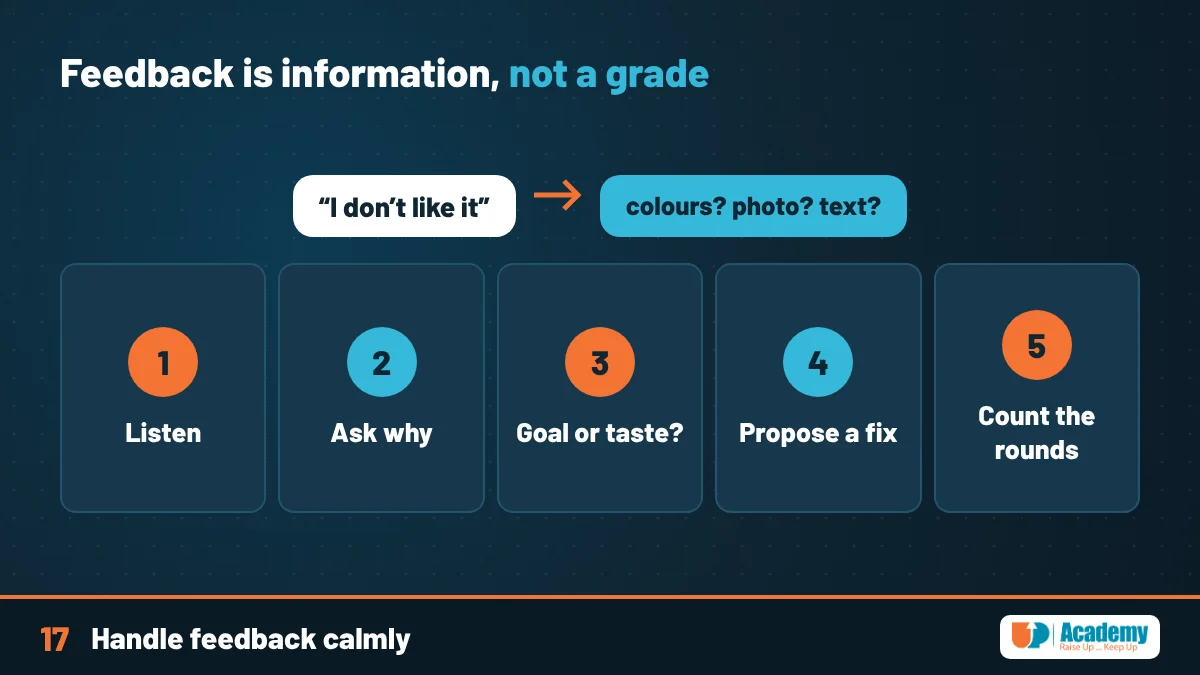
The first time a client says “I don’t like it”, many beginners hear “you are not a designer”. It does not mean that. Revisions are a normal part of every design job, for juniors and seniors alike. Feedback is information about the client’s goal, not a grade on your talent.
When a comment is vague (“make it pop”, “I don’t feel it”), ask why. “Is it the colours, the photo or the amount of text?” Separate comments about the goal (the price is not visible enough) from comments about taste (I prefer blue). Goal comments usually improve the design. Taste comments are the client’s right on their own brand, and you can suggest an option while explaining your reasoning once, calmly.
Count the rounds you agreed on, and when they are used, say kindly that further changes are a new round. Keep every version, so you can go back if the client changes their mind. And keep the lessons: each difficult comment shows you a question you should have asked in the brief, which makes your next job smoother.
After the First Job: Testimonials, Case Studies and Referrals
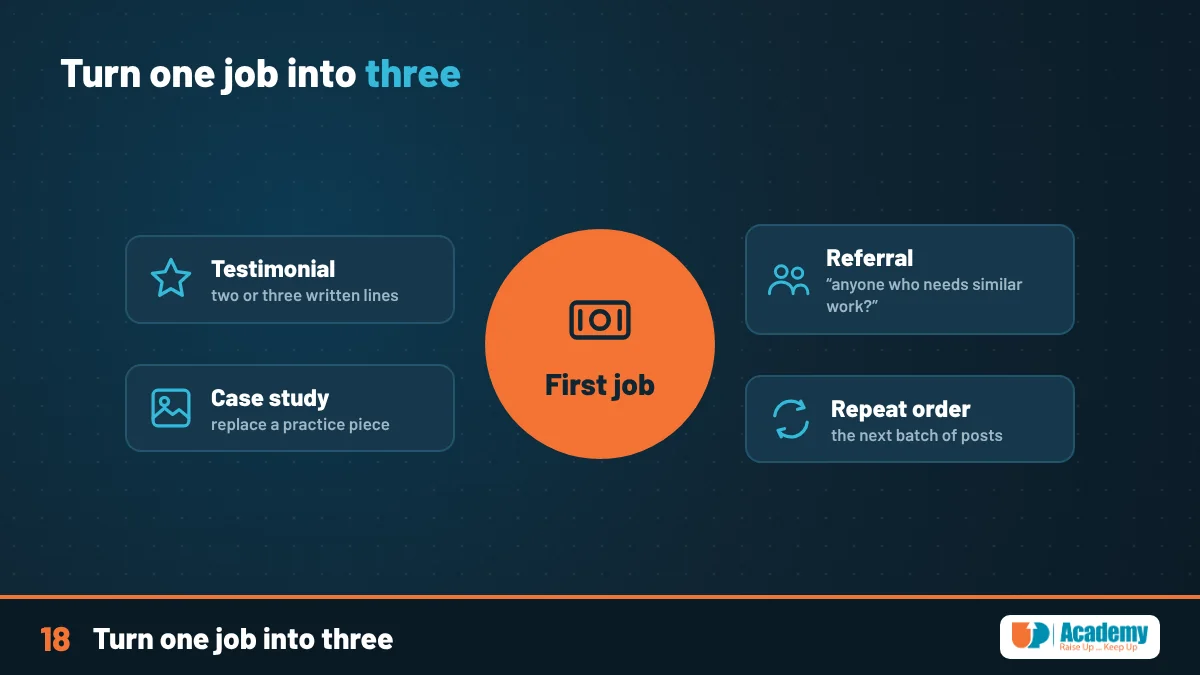
The first job is worth more than its price, if you use it. A few days after delivery, ask the client for two or three lines of written feedback and permission to show the work. People trust what other people say about you more than what you say about yourself, a well-known effect called social proof. One real testimonial next to the work beats any description you can write.
Turn the job into a new case study in your portfolio: the brief, your process, the final design and, if possible, a result (“the post reached twice the usual audience”, only if the client shares the number). It replaces one of your practice pieces with real client work, which is exactly what the next client wants to see.
Then ask simply: “If you know anyone who needs similar work, I would be happy to help them.” Small business owners know other small business owners. And offer the same client the next step: the next batch of posts, a menu update, a story template. A happy first client is the easiest second client.
Confidence for a Beginner Designer: Impostor Feelings and Speed Through Repetition
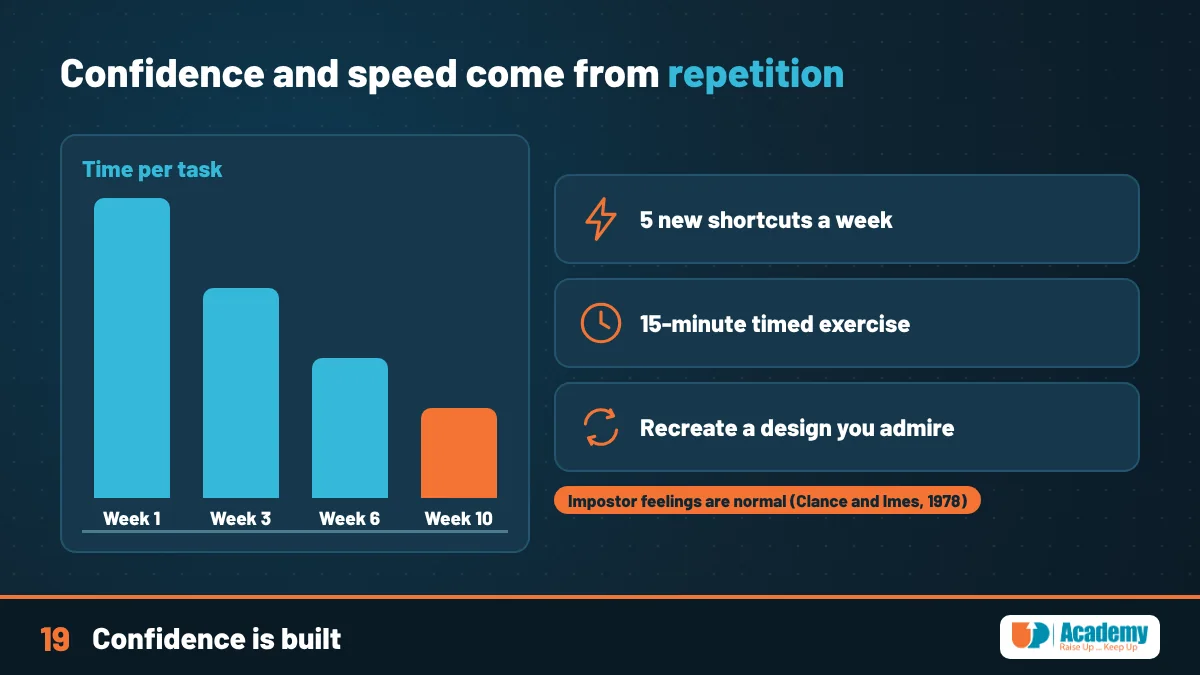
If you feel like a fraud while charging for your first design, you are in good company. The impostor phenomenon, described by psychologists Pauline Clance and Suzanne Imes in 1978, is common among capable people who doubt their own success. The feeling does not mean you are not ready. It usually means you care about doing the job well, which is a good sign in a designer.
Confidence does not come from waiting; it comes from evidence that you can do it, and evidence comes from repetition. Speed works the same way. Research on deliberate practice, led by K. Anders Ericsson, showed that focused practice on specific weaknesses, with feedback, is what separates experts from others. For a designer that means learning five new shortcuts a week, doing the same small task against a timer, and recreating a design you admire as a private study, not for publishing.
There is also a gap almost every creative person goes through: your taste improves faster than your hands, so for a while you can see that your work is not yet as good as you want. That gap closes with volume of work, not with talent. Every post you deliver shrinks it. Everyone started slow, including every designer whose portfolio you admire today.
Common Mistakes That Cost a Beginner Graphic Designer the First Clients
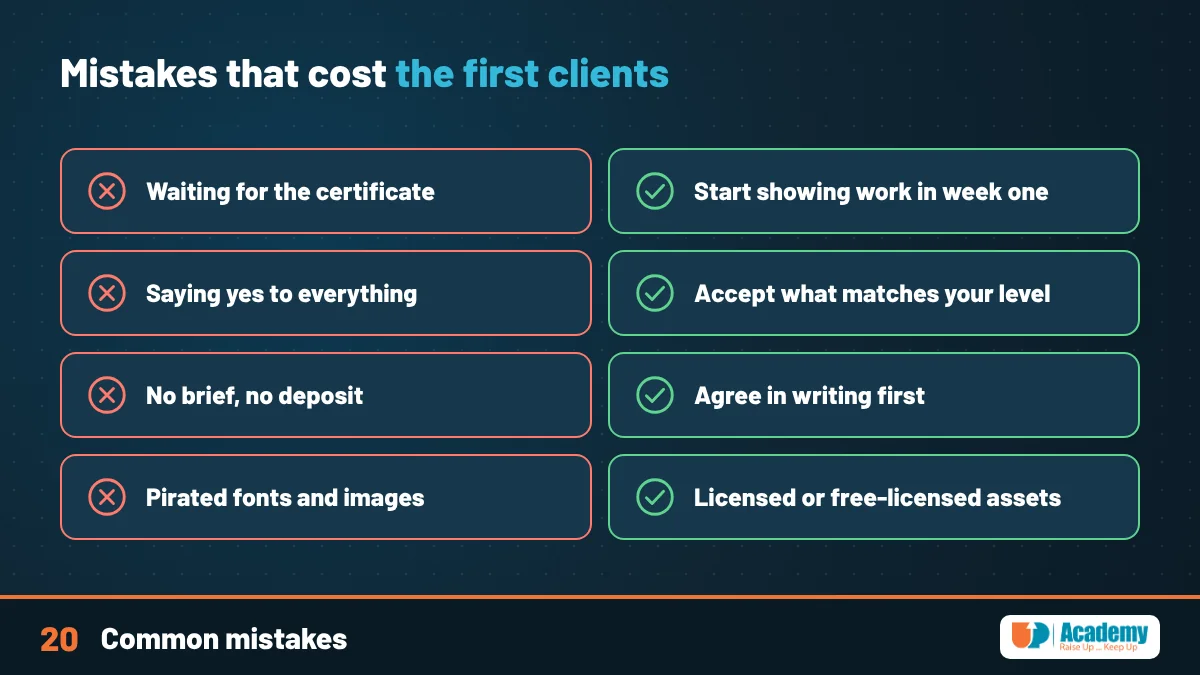
Waiting until the end of the course to start is the most expensive mistake, because you lose months of visibility and practice. Close behind it: a portfolio with thirty random exercises and no clear field, and a profile that says “all kinds of design”. Clients cannot see what you offer, so they move on.
In the work itself, the usual mistakes are accepting jobs beyond your current level without checking, starting without a written brief or agreement, unlimited revisions, no deposit, and silence when something goes wrong. Each of these turns a small job into a stressful one. A quick message to your instructor or the client almost always prevents the problem.
And there are mistakes that damage trust permanently: using cracked software, pirated fonts or images without a licence, copying a design you found online and presenting it as your own, or showing a concept as if it were client work. Use licensed or free-licensed resources (Adobe Fonts with your subscription, Google Fonts, licensed stock), credit your sources, and be honest. Your reputation is the only experience you are building from day one.
Beginner Graphic Designer Checklist: From the First Lesson to the First Client
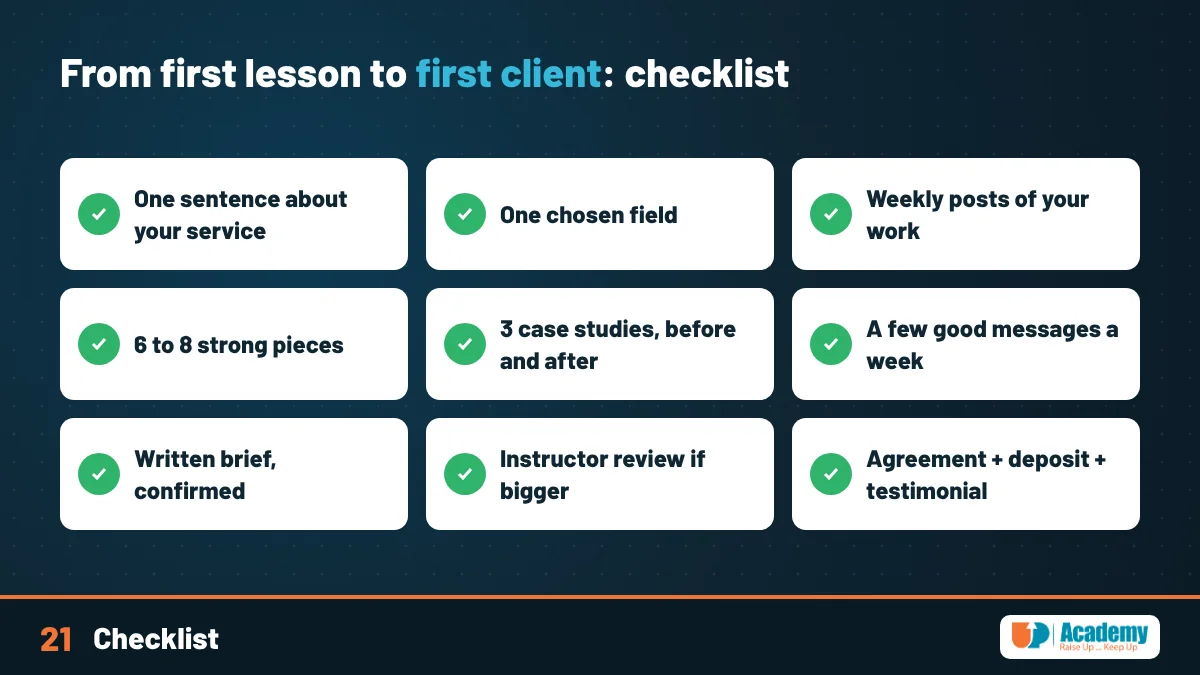
In the first two weeks: write one honest sentence about the service you offer and put it in your bios, choose the field you want to work in, and start posting your exercises every week. Open a Behance profile, even with one project. If you are not enrolled yet, the Mini Graphic Diploma covers foundations, Canva and the first steps that make this possible.
During the course: do every assignment on your field or the Starter Brand Kit, keep six to eight strong pieces, present three of them as short case studies with before and after, and send a few thoughtful messages to local businesses each week. Practise speed with short timed exercises, and bring your questions to the lessons and to the weekly live.
When a job comes: write the brief and confirm it, check with your instructor if it is bigger, technical or for print, agree in writing on deliverables, deadline, revisions and deposit, deliver organised files on time, then ask for a testimonial and a referral. Do this once and you are no longer “a student with no experience”; you are a designer with a first client. Have a question about which course fits your goal? Contact us or browse the course catalogue.
Beginner Graphic Designer: Frequently Asked Questions
Can a beginner graphic designer get paid work before finishing the course?
Yes. A beginner graphic designer can get small paid jobs mid-course if the job matches skills already practised, such as social media posts after Canva or product photo editing after Photoshop. What matters is a few relevant samples, a clear brief and agreement, and a review by your instructor before delivery for anything bigger or printed.
How many pieces should a beginner graphic design portfolio have?
Six to eight strong pieces are enough for a beginner graphic design portfolio. Choose work that resembles the jobs you want, ideally in one field, and present three of them as short case studies with the problem, process, solution and a before and after. Remove weaker pieces as your level rises.
How do I convince a client when I have no experience?
Talk about the client’s project instead of your experience. Ask clear brief questions, show the two or three samples closest to their request, explain your process and delivery date, and say honestly that an instructor reviews your work. Start with a small first task and a deposit to lower the risk for both sides.
Where does a beginner graphic designer find the first client?
Most first clients come from the closest circle: family, friends, neighbours and local shops that already trust you. Next come social media pages and small business groups, then freelance platforms such as Mostaql, Khamsat, Upwork and Fiverr, and finally agency jobs or internships. Start where trust already exists.
Should a beginner designer work for free to get experience?
Working for free usually hurts more than it helps, because it attracts clients who do not value design. Instead, build practice briefs and concept projects for your portfolio, and offer a small paid first task or a clearly stated introductory price. Avoid custom free samples made to win a job, known as spec work.
When should a beginner graphic designer ask the instructor before accepting a job?
Ask your instructor before accepting anything bigger than your current level: logos, print jobs, packaging, tight deadlines or a tool you have not studied yet. Send the brief, the client’s references and one clear question. At UP Academy you can ask from inside any lesson and receive an answer within 24 hours.
Written by the UP Academy team, drawing on more than twenty years of design and advertising experience of our founder, Mahmoud Nasr, over ten of them as an art director, and on following graphic design students through their first real jobs.