

The History of Marketing: From the Pharaohs to Artificial Intelligence, and How to Market Like a Pro

Have you ever wondered where marketing began? The history of marketing is much older than Facebook and Google, older even than newspapers and the printing press. Ever since the first merchant stood in an ancient market calling out his goods, marketing has existed in one form or another. What changed is its tools, its philosophy has evolved, and its audience today is smarter and busier than ever before.
In this UP Academy article, we take you on a journey through the evolution of marketing in 8 major milestones, from a papyrus in Thebes to artificial intelligence algorithms. Then we explain the components of marketing and what makes marketing successful, and we finish with practical steps to help you build a professional marketing plan for your business or your clients.
Table of contents
- What is marketing? A simple definition before we begin
- Milestone 1: Marketing in ancient civilizations
- Milestone 2: The Middle Ages, town criers and shop signs
- Milestone 3: The printing press and the birth of print advertising
- Milestone 4: The Industrial Revolution and the rise of brands
- Milestone 5: The golden age of radio and television
- How did the concept of marketing itself evolve? From production to society
- Milestone 6: The internet and the beginning of digital marketing
- Milestone 7: Social media, content and influencers
- Milestone 8: Marketing today with data and artificial intelligence
- The history of marketing in a timeline
- The components of marketing: the 4P and 7P marketing mix
- What makes marketing successful
- How to build a professional marketing plan step by step
- Common mistakes that ruin any marketing plan
- Why does a successful marketer need to understand design?
- Frequently asked questions about the history of marketing
- Conclusion
What is marketing? A simple definition before we begin

Many people think marketing is advertising, or that it is selling. The truth is that advertising and selling are a small part of the picture. The American Marketing Association (AMA) defines marketing as the activity and processes for creating, communicating, delivering and exchanging offerings that have value for customers, partners and society.
Put simply: marketing means understanding what people need, offering them what solves their problem, telling them about it in a convincing way, and keeping your relationship with them after the purchase. This definition will help us understand why marketing changed so much throughout history: because people, their needs and the ways to reach them changed.
Milestone 1: Marketing in ancient civilizations
The story of the history of marketing begins in ancient markets. In ancient Egypt, merchants displayed their goods in markets and relied on calling out and on reputation. A papyrus from the city of Thebes, about 3,000 years old, is often cited: its owner offers a reward for the return of a runaway, and at the same time mentions his shop and the quality of the cloth he weaves. In other words, he used the message to promote his business, which is a true marketing idea.
Similar ideas appeared in other civilizations:
- Seals and marks: craftsmen in Mesopotamia, Egypt and India put distinctive marks on pottery, bricks and products so buyers would know who made them. This is the earliest ancestor of the “brand”.
- Pompeii signs: in the Roman city of Pompeii, advertisements painted on walls were found for shops, offers and election candidates, along with sauce jars carrying the name of a famous merchant.
- Ancient China: the bronze printing plate of the Liu family needle shop from the Song dynasty, with its white rabbit logo, is considered one of the oldest known examples of a printed advertisement and a trade logo.
The lesson from this stage: even thousands of years ago, the smart merchant knew that trust, distinction and a name are what make people choose him over others.
Milestone 2: The Middle Ages, town criers and shop signs

In the Middle Ages most people could not read, so marketing relied on sound and image. The town crier walked the streets and markets announcing goods and news, and shop owners hung painted signs showing their trade: a shoe for the cobbler, scissors for the tailor, a bunch of grapes for the tavern.
At the same time, craft guilds regulated product quality, and a guild’s mark on a product was a guarantee for the buyer. In Arab markets, the “dallal” (broker) played a similar role, displaying goods, promoting them and bringing seller and buyer together. Here we see the seeds of quality assurance and visual identity that we still rely on today.
Milestone 3: The printing press and the birth of print advertising

In the mid-fifteenth century, Johannes Gutenberg developed movable-type printing, and everything changed. For the first time, the same message could be copied thousands of times at low cost. In 1477, the Englishman William Caxton printed a paper advertisement for a book he was selling, considered one of the oldest printed advertisements in the English language.
By the seventeenth century newspapers had spread across Europe, and advertising became a main source of their income. In Egypt, Al-Ahram newspaper was founded in 1875 and its pages carried ads for shops and goods for decades. The marketing message was no longer limited to one street or market; it now reached an entire city.
Milestone 4: The Industrial Revolution and the rise of brands

With the Industrial Revolution in the eighteenth and nineteenth centuries, factories produced huge quantities of similar products. The problem was no longer “how do I make it?” but “how do I get people to choose my product?”. This is where the brand in its modern sense was born.
- Packaging and name: instead of selling soap or flour “loose”, companies started packaging their products and putting their name and logo on them.
- Trademark registration: Britain passed the Trade Marks Registration Act in 1875, and the red triangle of Bass was one of the first registered trademarks.
- Advertising agencies: in 1841, Volney Palmer founded in Philadelphia what is considered the first advertising agency, buying space in newspapers and selling it to advertisers. Agencies later evolved to write and design the ads themselves.
This stage is what made design and visual identity an essential part of marketing. A product that can’t be recognized by its look gets lost among dozens of similar products on the shelf. Today that same identity reaches beyond the package into the whole space, as we explain in our guide to interior design branding.
Milestone 5: The golden age of radio and television

In 1922, the New York station WEAF aired what is considered the first paid radio advertisement. Less than twenty years later, in 1941, the first official TV commercial appeared, for Bulova watches before a baseball game, lasting about ten seconds. In Egypt, TV broadcasting started in 1960, and with it came commercials whose jingles many people still remember today.
In this era, from the 1950s to the 1980s, marketing became a huge industry: unforgettable slogans, advertising jingles and national campaigns. It also produced the most important theoretical tools: in 1960, Jerome McCarthy introduced the 4P marketing mix: Product, Price, Place and Promotion, a model still taught in every business school.
But marketing at that time was one-way: the company talks and the audience listens. No comments, no precise measurement and no real targeting.
How did the concept of marketing itself evolve? From production to society
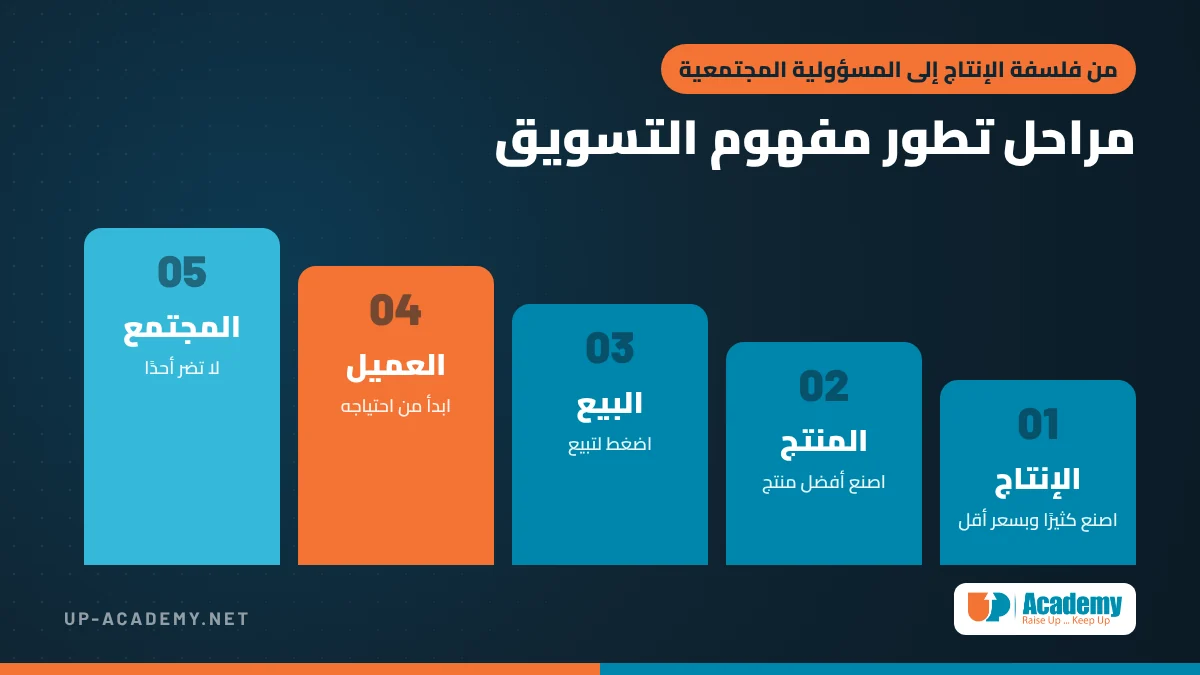
Alongside the evolution of tools, the way companies think about the market evolved too. Philip Kotler, the most famous marketing professor, divides this evolution into five main philosophies:
- The production concept: “Make a lot, sell it cheap, and people will buy.” It suited the age of scarcity after the Industrial Revolution.
- The product concept: “Make the best product and customers will come on their own.” It focuses on quality but ignores what the customer actually wants.
- The selling concept: “People won’t buy unless we push them.” This is where aggressive selling and heavy advertising appeared.
- The marketing concept: “Start from the customer’s need, then make what they want.” This is the most important shift in the stages of marketing evolution.
- The societal marketing concept: “Meet the customer’s need without harming society or the environment.” This is where the ideas of social responsibility and sustainability came from.
Today experts talk about Marketing 4.0 and 5.0, where human-centric marketing meets technology and data. And in 1981, Booms and Bitner added three elements to the marketing mix to suit services, making it the 7P, as we will explain shortly.
Milestone 6: The internet and the beginning of digital marketing

On 27 October 1994, the first banner ad appeared on the internet, on the HotWired website, asking the visitor: “Have you ever clicked your mouse right here? You will.” It achieved a very high click-through rate compared with any ad today, because the idea was completely new.
Then came Google in 1998, and its AdWords advertising service in 2000 (now Google Ads), and the rules of the game changed: for the first time an advertiser could appear to a person at the very moment they search for the product, pay only when they click the ad, and measure every pound spent. This gave rise to new specialties such as search engine optimization (SEO), email marketing and affiliate marketing.
Milestone 7: Social media, content and influencers

With the rise of Facebook (2004), YouTube (2005), Instagram (2010) and then TikTok, the relationship between brands and audiences was turned upside down. The audience no longer just receives; it comments, shares, criticizes and creates content itself. A single customer’s opinion in a post can now lift a brand up or tear it down.
This stage brought concepts such as:
- Content marketing: offering useful content (articles, videos, reels) that attracts the customer instead of chasing them with ads.
- Influencer marketing: working with people the audience trusts to present the product naturally.
- Precise paid ads: targeting by age, location, interests and behaviour, with budgets that start small.
- Communities: building groups and pages where customers gather around the brand.
Here design and visual content became the first language of marketing: users decide within two seconds whether to stop at your post or keep scrolling. If you want to learn to create professional social media and motion content, check out the Social Media & Motion module in the Graphic Design Diploma.
Milestone 8: Marketing today with data and artificial intelligence

We are now in the most exciting stage of the history of marketing. Data tells us who the customer is, when they buy and what makes them hesitate. And artificial intelligence now writes drafts, suggests designs, analyzes campaigns and personalizes ads for each individual.
- Personalization: every customer sees a message and an offer that suit them.
- Automation: welcome, follow-up and reminder messages that run automatically around the clock.
- Precise measurement: tools such as Google Analytics and Meta Ads Manager measure every click and every purchase.
- AI search: people now ask smart assistants instead of using traditional search, so trustworthy, useful content matters more than ever.
But be careful: tools alone don’t make successful marketing. AI speeds up execution, while understanding, strategy and creativity are still the human’s job. If you want to use these tools in design, the Canva & AI module is an excellent start. And if you’re interested in reading numbers and making data-driven decisions, the Data Analytics course will help you a lot.
The history of marketing in a timeline
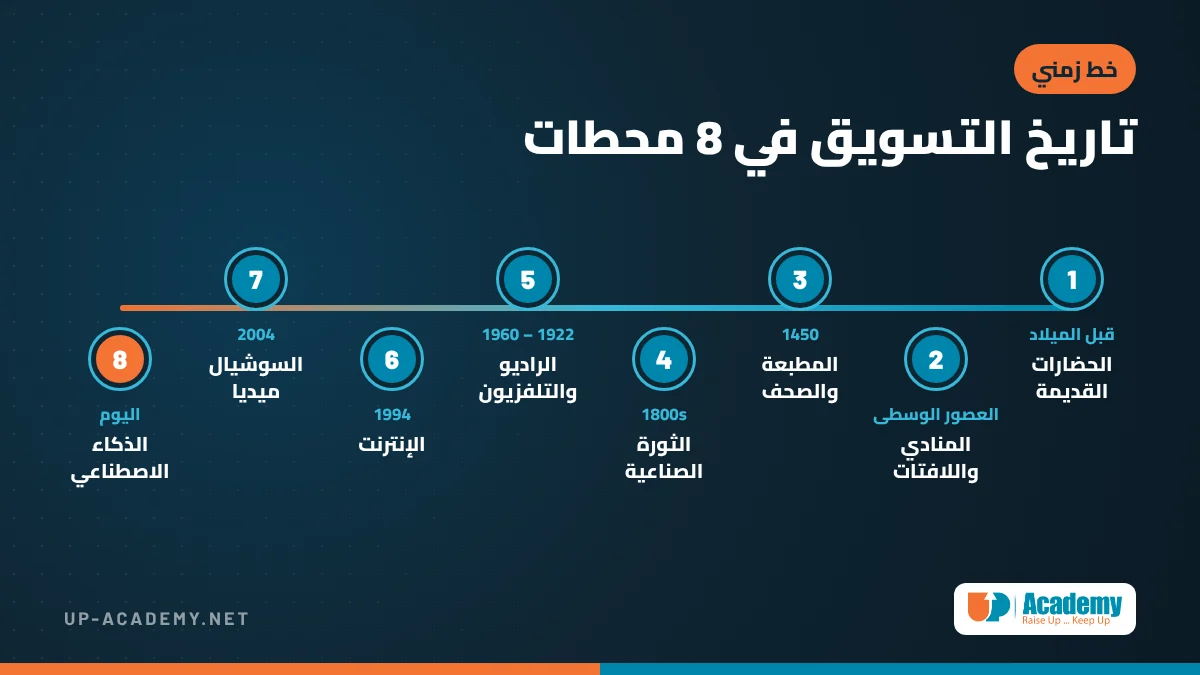
| Period | Milestone | What changed most |
|---|---|---|
| Before Christ | Ancient civilizations | Calling out, seals, the first written ads |
| Middle Ages | Town criers and signs | Shop visual identity and guild guarantees |
| 1450 – 1700 | Printing press and newspapers | The message reaches thousands |
| 1750 – 1900 | Industrial Revolution | Brands and advertising agencies |
| 1920 – 1990 | Radio and television | Mass advertising and the 4P marketing mix |
| 1994 – 2004 | The internet | Banners, search engines, measurable advertising |
| 2004 – 2020 | Social media | Content, influencers, precise targeting |
| Today | Data and AI | Personalization, automation and real-time measurement |
The components of marketing: the 4P and 7P marketing mix
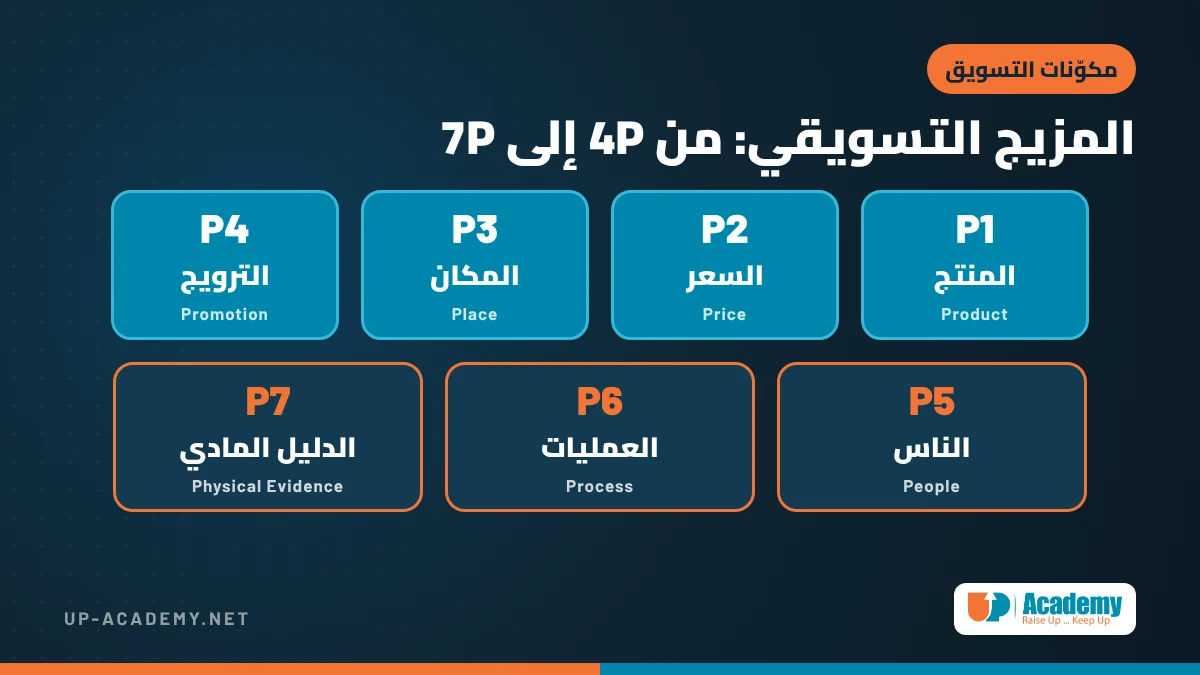
After this whole journey, what are the components of marketing that you actually control? The answer is the marketing mix:
- Product: what do you offer? What problem does it solve? What makes it different?
- Price: how much does the customer pay? Does the price reflect the value they get?
- Place: where does the customer find your product? In a shop, on a website, in an app, or on WhatsApp?
- Promotion: how do you tell people about it? Ads, content, public relations and offers.
- People: the team and customer service, who are the face of the brand.
- Process: the customer journey from first contact to after the purchase. Is it easy and smooth?
- Physical Evidence: everything the customer sees that proves your quality: design, website, packaging, certificates and customer reviews.
Notice that elements such as physical evidence and promotion depend heavily on design. That’s why building a strong visual identity and a professional logo is not a luxury but an essential part of any marketing plan.
What makes marketing successful
No matter how the tools change, successful marketing in every era shares these qualities:
- It starts with the customer: it understands their problem, language and fears before thinking about the ad.
- A clear, different message: the customer knows within seconds what you offer and why you specifically.
- Consistent: the same identity and the same tone everywhere, from the logo to the customer service reply.
- Honest and builds trust: exaggerated promises sell once and lose the customer forever.
- Measurable: it has clear goals and numbers that tell you what works and what needs to change.
- Flexible: it adapts quickly to changes in the market, platforms and audience behaviour.
How to build a professional marketing plan step by step

This is the practical part. Whether you own a small business or you are a designer offering services to clients, follow these steps to build a professional marketing plan:
1. Study the market and competitors
Who sells the same thing? At what price? What do their customers complain about? Customer comments on competitors’ pages are a real treasure of information.
2. Define your ideal customer (Persona)
Write a description of a real person: their age, job, problem, where they spend their time online, and what makes them buy or hesitate.
3. Write your value proposition and positioning
One sentence that explains who the product is for, what problem it solves, and why you are better than the alternatives. If you can’t write it clearly, the customer won’t understand it.
4. Set SMART goals
Instead of “I want more sales”, say: “50 new customers within 3 months from Facebook and Instagram ads.” A specific, measurable goal is what makes the plan actionable.
5. Choose the right channels
You don’t need to be everywhere. Be where your customer is: Facebook and Instagram for most audiences in Egypt, LinkedIn for companies, TikTok for young people, and Google for people looking for a solution right now.
6. Plan your content and design
Make a monthly content calendar that mixes educational content, trust-building content (customer reviews, behind the scenes) and sales content. And take care of design, because it is the first thing the customer sees.
7. Set the budget
Start with a small test budget, try more than one ad and message, then increase spending only on what works.
8. Measure, analyze and improve
Track clear indicators: cost per customer, conversion rate and return on ad spend. Professional marketing is not a single campaign but a continuous cycle of testing and improvement.
Common mistakes that ruin any marketing plan
- Starting ads before understanding the customer and preparing a clear offer.
- Copying competitors literally instead of looking for a real point of difference.
- Random designs with no unified visual identity.
- Judging a campaign after two days, or running it for months without measuring.
- Neglecting the customer after the purchase, even though keeping a customer is much cheaper than winning a new one.
Why does a successful marketer need to understand design?
If you trace the history of marketing from the first seal on a clay jar to the latest ad on Instagram, you will find one constant: the image comes before the word. A brand with a strong visual identity and professional designs wins the customer’s attention and trust faster.
That’s why at UP Academy we designed the Graphic Design Diploma to take you from design basics to visual identity and social media, all the way to building your portfolio and freelancing. You can browse all available courses in the course catalog.
Frequently asked questions about the history of marketing
When did marketing begin?
The first forms of marketing began with trade itself in ancient civilizations, through calling out in markets and seals and marks on products, and there are written examples dating back about 3,000 years.
What are the stages of marketing evolution?
In terms of philosophy, marketing went through five stages: the production concept, then the product concept, then the selling concept, then the marketing concept that starts with the customer, and finally the societal marketing concept. In terms of tools, it moved from calling out to the printing press, then radio and television, then the internet, social media and artificial intelligence.
What is the difference between marketing and advertising?
Advertising is part of promotion, and promotion is one element of the marketing mix. Marketing includes understanding the customer, developing the product, pricing, distribution, promotion and after-sales service.
Is traditional marketing dead?
No, but it is no longer alone. Signs, TV and events are still effective for some businesses, and the best approach is usually to combine traditional and digital channels depending on where your audience is.
Conclusion
The history of marketing is really the history of the relationship between seller and buyer. The tools changed from the town crier’s voice to AI algorithms, but the rule hasn’t changed: understand your customer, offer them real value, communicate with them in their language and where they are, then measure and improve continuously. Start today by writing your value proposition and defining your ideal customer, and you will find the rest of the steps much clearer.
Tell us in the comments: which milestone in the history of marketing surprised you the most? And if you want to develop your design and visual marketing skills, discover UP Academy courses here.
Written by Dr. Mahmoud Nasr, founder of UP Academy, PhD in Applied Arts from Helwan University, with more than 20 years of experience in design and advertising, including over 10 years as an Art Director.